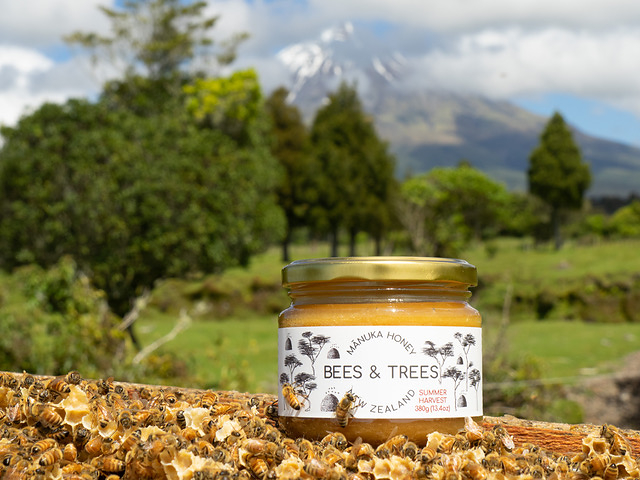
New Zealand-sourced Bees & Trees Mānuka Honey is marking 15 years in the U.S. market, a milestone the family-owned producer is leveraging heading into fall cold-and-flu season and holiday gifting — two of the highest-velocity windows for premium honey in specialty food and independent retail channels.
The Product Lineup
The brand's three-tier SKU structure runs from a 350+ MGO "Mid-Activity" entry point through a 550+ MGO "High-Activity" mid-tier and a 830+ MGO "Founder's Reserve" at the top, priced $33–$65. Each batch carries independent third-party MGO verification, a point of differentiation that matters to specialty food buyers navigating a category where adulteration and mislabeling remain persistent concerns. A gift box paired with a wooden honey spoon retails at $41, positioning the line squarely in the holiday gifting set alongside premium olive oils, aged balsamic, and artisan preserves.
Vertical Integration as Supply Advantage
Bees & Trees controls approximately 1,200 to 1,500 hives in the eastern Taranaki hill country on New Zealand's North Island — terrain so remote that helicopter transport is required for some hive sites. Post-harvest, the honey is extracted and aged 12 to 24 months under controlled temperatures before packing in glass jars. The company does not pasteurize, a process-integrity claim that resonates with the wellness-oriented specialty consumer and differentiates the brand from commodity honey on foodservice distributor broadline shelves.
That hive-to-jar model gives the U.S.-based company direct oversight of provenance at every step — a supply-chain posture that is increasingly table stakes for premium ingredients entering specialty retail and foodservice procurement. For foodservice operators sourcing honey for menu applications — whether in craft cocktails, charcuterie boards, or wellness-forward breakfast dayparts — independent MGO certification and traceable origin reduce specification risk.
Retail and Channel Positioning
Distribution runs through direct-to-consumer, Amazon, and select specialty and independent retailers. The brand has not disclosed foodservice distribution partners, but the culinary positioning — applications in savory glazes, cheese boards, and premium tea programs — maps to the upscale casual and fine-dining segments where ingredient provenance drives menu storytelling. Mānuka honey's bioactive profile, specifically dietary methylglyoxal (MGO) and its associated antimicrobial properties, has been the subject of peer-reviewed research, giving foodservice wellness programs a science-adjacent narrative increasingly in demand at hotel F&B and health-casual concepts.
Founder Mike Everly launched the brand in 2011 after living in New Zealand; the family returned to the U.S. in 2012 and has operated the New Zealand production facility continuously since. At 15 years, Bees & Trees occupies an established position in a Mānuka category that has grown competitive as Australian and counterfeit-risk product has expanded shelf presence in mainstream grocery — making verified MGO rating and vertically integrated sourcing a durable commercial argument for retail buyers and foodservice procurement teams alike.
Written by Michael Politz, Author of Guide to Restaurant Success: The Proven Process for Starting Any Restaurant Business From Scratch to Success (ISBN: 978-1-119-66896-1), Founder of Food & Beverage Magazine, the leading online magazine and resource in the industry. Designer of the Bluetooth logo and recognized in Entrepreneur Magazine's "Top 40 Under 40" for founding American Wholesale Floral, Politz is also the Co-founder of the Proof Awards and the CPG Awards and a partner in numerous consumer brands across the food and beverage sector.