The Product
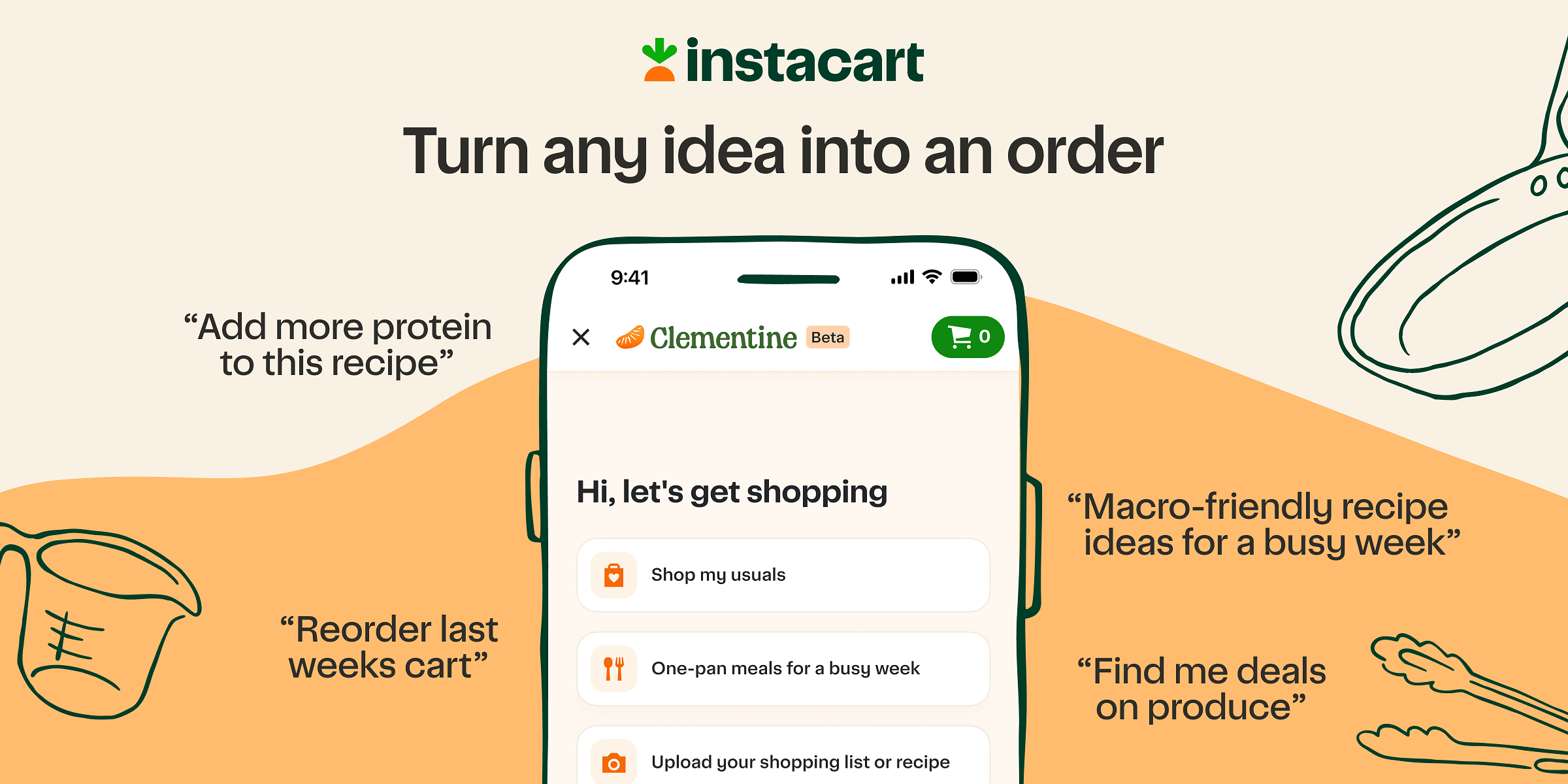
Instacart (NASDAQ: CART) launched Clementine, a consumer-facing AI shopping assistant, across the Instacart Marketplace for most U.S. and Canadian customers on September 9. The tool converts plain-language prompts — "high-protein easy dinners for two" or "everything for a football watch party for 20" — into personalized, ready-to-buy carts, pulling real-time inventory data from the customer's selected store. Early basket data are notable: orders placed through Clementine already exceed Instacart's platform-wide average basket size of $115, and they tend to contain more line items than a typical Instacart transaction.
The intelligence layer behind Clementine is substantial. Instacart reports more than 1.6 billion lifetime orders processed, a catalog exceeding 2 billion items, and more than 10 million daily inventory signals drawn from nearly 100,000 stores across more than 2,200 retail banners in North America — figures as of December 31, 2025. That data depth allows the assistant to surface in-stock items, flag relevant promotions, suggest lower-cost substitutions, and apply household dietary preferences — gluten-free, nut-free, organic — set once in a preference center. A grocery-list photo upload feature converts a handwritten or screenshotted list into a cart in seconds.
The Retail Operator Angle
For grocery operators, the more commercially significant announcement may be Cart Assistant, Instacart's white-label enterprise version of the same technology. Food Bazaar, Heritage Grocers Group, and Woodman's are already live with retailer-branded deployments on their own websites and apps; ALDI U.S., Harmon's, The Save Mart Companies, and Stew Leonard's are listed as forthcoming partners. Cart Assistant lets independent and regional grocers offer an agentic shopping experience — complete with loyalty integration, branded tone, and their own catalog data — without building the AI infrastructure in-house. In a grocery landscape where large-format chains and mass retailers continue to expand digital fulfillment capabilities, Cart Assistant functions as a competitive-parity tool for operators that lack the engineering headcount of a Kroger or Walmart.
The assistant category also extends into third-party AI ecosystems. Instacart has active integrations with Anthropic's Claude, OpenAI's ChatGPT, and Google's Gemini and AI Mode in Search, meaning a grocery conversation that starts in any of those environments can route directly to an Instacart checkout. For foodservice-adjacent retailers — prepared-foods departments, meal-kit adjacents, deli operators — that distribution surface matters: it places Instacart at the top of the meal-planning funnel, upstream of the retailer's own app.
What's Next
User-behavior data from the rollout offers an early pattern worth tracking: customers reportedly begin with low-friction reorder tasks, then migrate toward higher-complexity use cases like recipe discovery and occasion-based shopping. Chris Rogers, CEO of Instacart, framed the platform's advantage as nearly 15 years of household purchase data — a moat that Clementine is designed to convert into session engagement and incremental basket size. For grocery technology vendors and retail operators evaluating their own digital roadmaps, the Clementine launch signals that conversational, agentic commerce is moving from pilot to standard expectation among platform-scale players. Regional chains and independent grocers now have a concrete white-label path to participate via Cart Assistant rather than build from scratch.
Instacart's dual-track approach — consumer assistant on the marketplace, enterprise assistant on retailer storefronts — mirrors the platform-plus-SaaS models gaining traction across foodservice technology and grocery e-commerce categories, where the same AI layer can generate both direct consumer revenue and recurring B2B licensing income.
Written by Michael Politz, Author of Guide to Restaurant Success: The Proven Process for Starting Any Restaurant Business From Scratch to Success (ISBN: 978-1-119-66896-1), Founder of Food & Beverage Magazine, the leading online magazine and resource in the industry. Designer of the Bluetooth logo and recognized in Entrepreneur Magazine's "Top 40 Under 40" for founding American Wholesale Floral, Politz is also the Co-founder of the Proof Awards and the CPG Awards and a partner in numerous consumer brands across the food and beverage sector.